How to Use a Jigger: oz, ml & Common Cocktail Measurements
Approx. 9 min read
The quick answer: common jigger measurements
If a cocktail recipe uses ounces and your jigger is marked in milliliters, you usually do not need a calculator. For home mixing, these are the practical conversions worth remembering:
- 1/4 oz = 7.5 ml
- 1/2 oz = 15 ml
- 3/4 oz = 22.5 ml
- 1 oz = 30 ml
- 1 1/2 oz = 45 ml
- 2 oz = 60 ml
Technically, 1 US fluid ounce is about 29.57 ml, so the numbers are not perfectly identical. Cocktail recipes normally use the clean 30 ml equivalent because it is practical, repeatable and easy to measure with standard bar tools.
What is a cocktail jigger?
A jigger is a small measuring tool used to portion spirits, citrus juice, syrups, vermouth and other cocktail ingredients. Most are double-ended, with a larger cup on one side and a smaller cup on the other. Many modern jiggers also have internal lines for fractional measurements.
The important part is not owning the most professional-looking jigger. It is being able to see your measurements clearly and hit the same amount every time. If you are building a home setup from scratch, our cocktail tools for beginners guide explains why a jigger is one of the most useful first purchases.
How to use a jigger in 4 simple steps
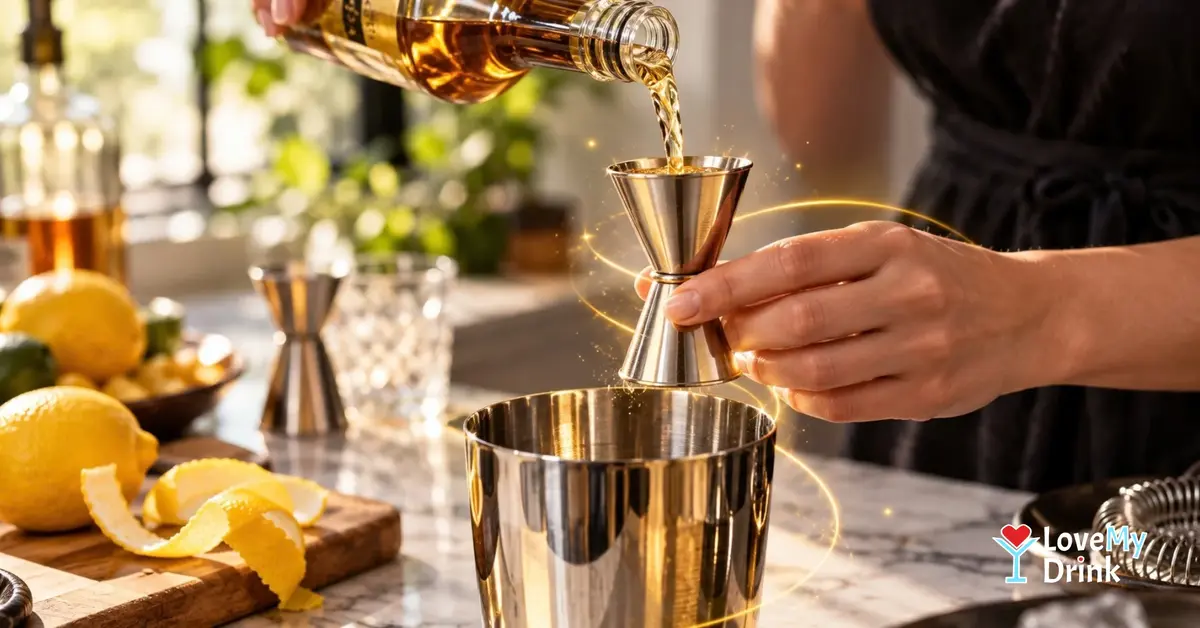
- Hold the jigger over your shaker, mixing glass or serving glass. That way, a small spill lands where the drink is going anyway.
- Pour the ingredient steadily until the liquid reaches the measurement line or the rim you need.
- Stop the pour cleanly rather than letting the bottle keep dribbling into the jigger.
- Tip the full measure into the drink and move straight to the next ingredient.
For most home cocktails, that is all there is to it. You do not need bartender speed. Accuracy first, speed later.
How to read the lines inside a jigger
This is where many beginners get confused, because not every jigger is marked the same way. A 2 oz side might have lines for 1 oz and 1 1/2 oz. A smaller side might include 1/4 oz, 1/2 oz or 3/4 oz marks. Metric versions may show 10, 15, 20, 25, 30, 45 or 60 ml instead.
Before making the drink, take ten seconds to check what your own jigger actually says. Do not assume that every internal line represents the same fraction across different brands.
The easiest habit is to choose the exact line before you start pouring. If the recipe says 22.5 ml or 3/4 oz, find that line first, then pour. It sounds obvious, but it prevents the classic mid-pour guessing game.
Is there a standard jigger size?
Not really. There are common formats, but no single jigger size that every bartender or manufacturer uses. A very common double jigger pairs 1 oz with 2 oz, while Japanese-style jiggers often use a tall, narrow shape with several internal markings. Smaller 1/2 oz and 1 oz combinations also exist.
That is why a recipe should be followed by the measurement itself, not by instructions such as “one jigger.” If one person owns a 30/60 ml jigger and another owns a smaller one, “one jigger” can mean two very different pours.
The cocktail measurement cheat sheet
1/4 oz = 7.5 ml
This is a small but useful measure for simple syrup, liqueurs or modifiers. The Old Fashioned is a good example: our beginner recipe uses 60 ml (2 oz) whiskey with 7.5 ml (1/4 oz) simple syrup.
1/2 oz = 15 ml
One of the easiest marks to remember. It appears constantly in cocktail recipes for citrus, syrup, vermouth and liqueurs. In many kitchen measure systems, that is also a tablespoon, but tablespoon sizes can vary by country. For cocktails, 15 ml is the safer reference.
3/4 oz = 22.5 ml
This one shows up often in sour-style drinks. It is also the easiest way to understand the Paper Plane: choose the 22.5 ml (0.75 oz) line and use that same mark for all four ingredients.
1 oz = 30 ml
This is the basic cocktail building block. Equal-parts recipes often become much easier once you think of them as repeating the same 30 ml or 1 oz pour.
1 1/2 oz = 45 ml
A common base-spirit measure in modern recipes. If your jigger has a 2 oz or 60 ml large side, look for the internal 1 1/2 oz or 45 ml line rather than trying to eyeball three quarters of the cup.
2 oz = 60 ml
A very common full base-spirit pour for classics. Our Classic Martini, for example, starts with 60 ml (2 oz) gin or vodka and 15 ml (0.5 oz) dry vermouth.
US ounces vs UK fluid ounces: one small detail worth knowing
Most cocktail recipes that pair ounces with milliliters are effectively using US fluid ounces. One US fl oz is about 29.57 ml, which is why 30 ml is the practical cocktail equivalent. A UK Imperial fluid ounce is smaller at about 28.41 ml.
For normal home mixing, do not try to correct every recipe to several decimal places. Use one measurement system consistently within the drink. If the recipe gives 30 ml / 1 oz, follow either side of that pair throughout and your ratios will stay where they should.
Three real cocktails that make jigger measurements easy
Paper Plane: repeat one line four times
The Paper Plane is almost a jigger practice drill disguised as a cocktail. Our version uses 22.5 ml (0.75 oz) each of bourbon, Aperol, Amaro Nonino and fresh lemon juice. Find one mark and hit it four times.
Martini: learn 2 oz and 1/2 oz
A simple dry Martini teaches two very common measurements: 60 ml (2 oz) spirit and 15 ml (0.5 oz) dry vermouth. Once those two marks feel familiar, dozens of other recipes become easier to read.
Old Fashioned: learn the small 1/4 oz pour
The Old Fashioned is useful because it combines a large base pour with a tiny modifier. Measure 60 ml (2 oz) whiskey, then 7.5 ml (1/4 oz) syrup. That small measure is exactly where a jigger earns its keep: guessing a little sweetness can change the drink surprisingly quickly.
Which jigger should you buy?
Look for clear markings before anything else. A beautiful jigger with lines you cannot read quickly is less useful than a simple one that makes 15, 22.5, 30, 45 and 60 ml easy to find.
For beginners, I would choose either a clearly marked Japanese-style jigger or an easy-read measuring design. If you already know you make mostly classic stirred drinks, a heavier traditional double jigger can also feel great in the hand.
As an Amazon Associate I earn from qualifying purchases.
- Japanese-style cocktail jigger on Amazon — a good traditional shape if you want multiple marked measures in one tool.
- Angled measuring jigger on Amazon — a beginner-friendly option if you prefer measurements that are easy to read from above.
- Classic double jigger on Amazon — a more polished home-bar option if you like a traditional look and feel.
Whichever style you choose, readable markings matter more than brand or shape. The best jigger is the one that stops you guessing.
Common jigger mistakes
Eyeballing an internal line
If you are already using a measuring tool, use the mark. Small errors matter most with citrus, syrup, bitters-style modifiers and strong liqueurs because they can shift balance quickly.
Filling above the rim
A rounded dome of liquid above the edge is no longer the marked measure. Fill cleanly to the line or rim and pour it into the drink.
Switching between approximate systems mid-recipe
Using 30 ml for one ingredient, then trying to calculate another measurement from an exact ounce conversion, creates needless inconsistency. Pick the ml side or the oz side of the recipe and stay with it.
Assuming every jigger has the same capacity
Check the markings on your own tool. “Small side” and “large side” are not universal units.
Jigger measurements FAQ
How many ml are in 1 oz for cocktails?
Use 30 ml as the practical cocktail equivalent of 1 US fl oz. The exact conversion is about 29.57 ml, but cocktail recipes normally round it for easy measuring.
How many ml are in 3/4 oz?
Use 22.5 ml. This is a very common cocktail measurement for citrus juice and other ingredients in sour-style recipes.
How many ml are in 1/2 oz?
Use 15 ml. In many kitchen measure systems that is also a tablespoon, but tablespoon sizes can vary by country.
What if my jigger does not have the measurement I need?
Combine smaller marks. For 22.5 ml, for example, you can measure 15 ml plus 7.5 ml. A marked kitchen measuring spoon or small measuring cup can also help when your jigger skips a useful fraction.
Do I need a jigger to make cocktails?
No. Accurate measuring is the goal, not the tool itself. Measuring spoons or a small marked cup can work. A jigger simply makes repeated cocktail pours faster and easier once you start mixing regularly.
Should I measure directly over the shaker?
Yes, especially while you are learning. If a few drops spill, they land in the drink rather than on the counter. Just avoid letting an accidental heavy pour run straight past the jigger into the shaker.
Measure once, then stop thinking about it
A jigger should make cocktails feel easier, not more technical. Learn six marks — 7.5, 15, 22.5, 30, 45 and 60 ml — and you can follow a huge number of cocktail recipes without doing maths at the bar.
Start with one drink you already like and measure it carefully once. After a few rounds, the lines that looked confusing at first will become the easiest part of the recipe.