Bourbon for Beginners: What It Is, How to Taste It & How to Drink It
Approx. 8 min read
Bourbon in 30 seconds
Bourbon is whiskey with a specific set of U.S. rules. For a whiskey to be labeled bourbon, it must be distilled and aged in the United States, made from a mash containing at least 51% corn, distilled at no more than 160 proof (80% ABV), and put into new charred oak at no more than 125 proof (62.5% ABV).
- Bourbon is whiskey.
- At least 51% of the mash must be corn.
- It goes into new charred oak.
- It does not have to come from Kentucky.
- Bourbon itself has no federal minimum aging time; straight bourbon has at least two years in new charred oak.
Plain bourbon also cannot use added coloring, flavoring or blending materials under the federal standard. If you want the technical version, the current U.S. whisky standard in 27 CFR § 5.143 sets out the production and labeling rules.
That is enough law for one glass. The more useful question is what the bourbon in front of you tastes like, and what happens when you change only the way you serve it.
Bourbon vs whiskey: what is the difference?
Whiskey is the bigger category. Bourbon is one type inside it. The easiest line to remember is: all bourbon is whiskey, but not all whiskey is bourbon.
Rye whiskey uses rye as its defining grain. Scotch and Irish whiskey follow their own regional rules. Bourbon's corn requirement and new charred oak often push it toward vanilla, caramel, toasted wood and baking-spice flavors, but every bottle has its own balance.
Does bourbon have to come from Kentucky?
No. The word bourbon is not limited to Kentucky. A bourbon can be made elsewhere in the United States if it follows the federal standard.
Kentucky became synonymous with bourbon through a long distilling tradition and an unusually dense bourbon industry. For a beginner, though, the useful distinction is simple: Kentucky is at the heart of bourbon culture, but Kentucky is not part of the federal definition.
What does bourbon taste like? Start with four anchors
Ignore the tasting wheel for now. On a first glass, four broad impressions are more useful than hunting for a perfect list of flavors.
- Sweet: vanilla, caramel, brown sugar or toffee.
- Spiced: cinnamon, clove, pepper or baking spice.
- Woody: oak, toast, char or a dry finish.
- Fruity: cherry, apple, orange peel or dried fruit.
You may find all four. You may only think, “sweet, warm and woody.” That still counts. Tasting is not a quiz, and your glass does not need to match the notes printed on the bottle.
The one-bottle, three-pour bourbon test
This is the Love My Drink shortcut: keep the bourbon the same and change only the serve. You will learn more about what you enjoy than you will by opening three unrelated bottles at once.
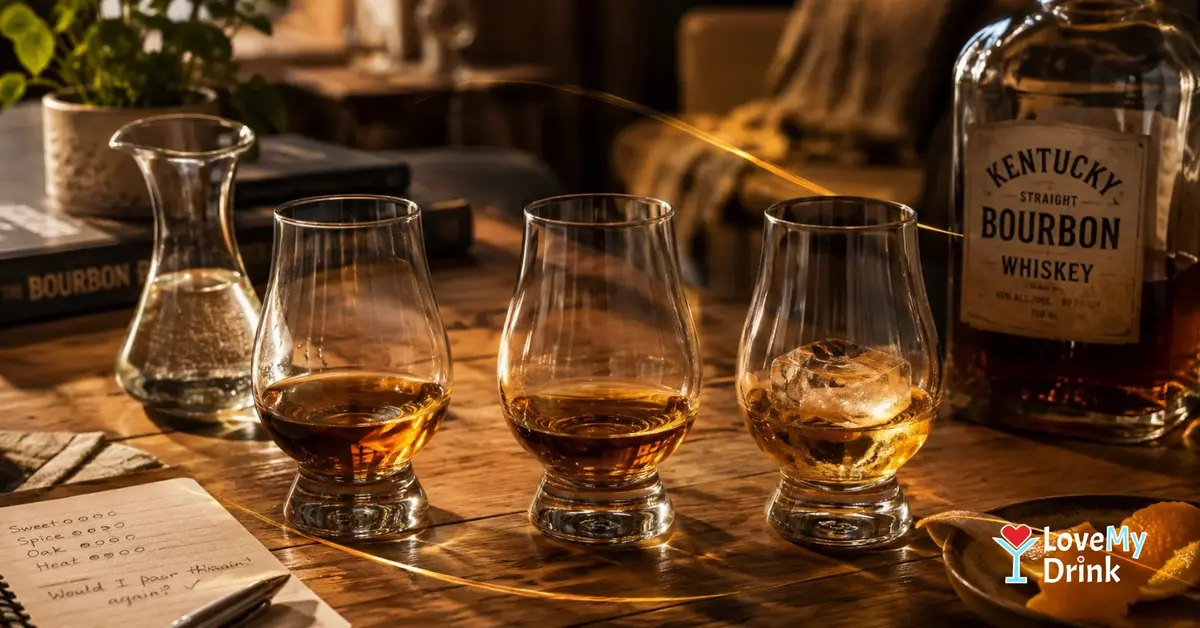
Pour about 15 ml (0.5 oz) for each version. If you have three small glasses, line them up side by side. If not, use one glass and taste in sequence. Keep still water and a little fresh ice nearby.
A tulip-shaped whisky glass helps keep the aroma focused, but it is not a requirement. A small wine glass works too.
Affiliate disclosure: This article contains an affiliate link. If you buy through it, Love My Drink may earn a commission at no extra cost to you. As an Amazon Associate, we earn from qualifying purchases.
If you want matching glasses for a small tasting, this Glencairn Whisky Glass Set of 4 is a practical option. If you already have suitable small glasses at home, use those first.
Pour 1: neat
Start at room temperature with nothing added. Smell gently rather than pushing your nose deep into the glass. Take a small sip and give the alcohol a moment to settle before deciding what you taste.
Ask: Is it sweet or dry? Soft or hot? Do you notice spice, fruit or oak? Most importantly, would you happily take another sip this way?
Pour 2: add a few drops of water

Add only a few drops of still water. Taste again. The small drop in alcohol concentration can change how aroma, sweetness and spice come across.
Do not assume water is supposed to improve the bourbon. Compare. If the glass feels more open and comfortable, that is useful. If it feels thinner or less interesting, that is useful too.
Pour 3: add ice
For the last small pour, add one fresh ice cube and give it a short moment to chill. Cold can soften the alcohol impression, while melting ice adds dilution as you drink.
You may find this version easier and smoother. You may also notice less aroma. Neither answer is wrong. Circle the version you would actually pour again.
The Bourbon Compass: keep only four notes
Instead of scoring the whiskey out of 100, write four quick impressions for each pour. Use simple words such as low, medium and high.
- Sweetness: low / medium / high
- Spice: soft / medium / bold
- Oak: light / medium / strong
- Heat: soft / warm / hot
Then add one final question: Would I pour this version again? That answer is your compass. It turns tasting notes into an actual decision instead of a vocabulary exercise.
If bourbon still tastes too strong
Alcohol heat can dominate a first sip before you notice much else. That does not automatically mean you dislike bourbon.
- Take a smaller sip.
- Give the glass another minute before the next taste.
- Add a few drops of water rather than a large splash.
- Try it over ice.
- Move into a longer mixed drink instead of forcing yourself to enjoy it neat.
Use the result, not the rules
Your favorite version tells you more than a generic “best way to drink bourbon” rule ever could.
Neat was your favorite
You probably enjoy the whiskey staying in front. If you want your first cocktail to keep that character, an Old Fashioned for beginners is the natural next step: bourbon, a little sweetness and bitters, with the spirit still leading.
Water made it better
Keep doing exactly that. A few drops can be your normal serve. If you want to move into a cocktail without burying the whiskey, choose something balanced and measured rather than very sweet.
Ice made it easier
You may simply prefer bourbon colder and softer. Try it on the rocks, or move toward a longer serve such as a Whiskey Highball or Whiskey Ginger. Our easy whiskey cocktails for beginners starts with the lighter options before moving into stronger classics.
You liked the flavor but wanted brightness
That points toward citrus. A balanced Whiskey Sour keeps the bourbon recognizable while lemon and sugar make the drink brighter and easier to read.
If honey sounds better than a sharper sour, the Gold Rush in our beginner whiskey list is the softer direction. The point is not to graduate from “wrong” bourbon drinking to “right” bourbon drinking. It is to use one tasting to find the next glass you are more likely to love.
Three beginner mistakes that make bourbon harder than it needs to be
1. Starting with a huge pour
You need enough to smell and sip, not a full tumbler. Small pours make comparison easier and stop the tasting from becoming tiring halfway through.
2. Hunting for the correct tasting notes
If someone else finds cherry and you find vanilla, nobody has failed. Start with broad impressions. Add more specific words only when they genuinely help you remember the bottle.
3. Treating neat bourbon as the grown-up answer
Neat is one serve, not a test of seriousness. Water, ice and cocktails all change bourbon in useful ways. The best result is the version you know you want to pour again.
Bourbon for beginners: quick FAQ
Is bourbon the same as whiskey?
Bourbon is a type of whiskey. All bourbon is whiskey, but other whiskies follow different grain, production, storage or regional rules.
Does bourbon have to be made in Kentucky?
No. Under U.S. rules, bourbon must be distilled and aged in the United States, but it can be made outside Kentucky.
Is bourbon sweeter than other whiskey?
Bourbon often gives an impression of sweetness through notes such as vanilla, caramel and brown sugar, but the actual profile depends on the grain recipe, barrel, age, proof and producer.
Should a beginner drink bourbon neat?
Taste a small neat pour first because it gives you a useful baseline. Then try water and ice. Keep the version you enjoy most.
Can you add water to bourbon?
Yes. A few drops can change how the aroma, alcohol heat and flavors come across. Add a little at a time so you can compare rather than simply dilute the glass.
What does straight bourbon mean?
Straight bourbon meets the bourbon production rules and has spent at least two years in new charred oak. “Straight” therefore tells you something specific about aging, not just style.
Start with one bottle, not a collection
Your first useful bourbon lesson can happen with one bottle already on your shelf. Pour it three small ways, mark sweetness, spice, oak and heat, then choose the version you would happily pour again.
That is enough. No tasting exam. No rare bottle hunt. Just one glass getting more interesting because you now know what to change next.