How to Cut Citrus Garnishes for Cocktails: 6 Easy Shapes
Approx. 9 min read
Start with three tools, not a full bar kit
For most citrus garnishes, a stable cutting board and one sharp small knife are enough. The extra tools are shortcuts, not requirements.
- Small sharp paring knife: The best all-round option for wedges, wheels, half-wheels and trimming peel. If you want one tool that covers most of this guide, this small sharp paring knife is the practical place to start.
- Vegetable or Y-peeler: Useful for broad lemon and orange peels. A good Y-peeler helps you take off a clean strip of zest without digging too deeply into the fruit.
- Channel knife or citrus zester: Optional, but useful for long, narrow spirals. This channel knife / citrus zester makes that decorative shape much easier than trying to carve it freehand.
If you are buying only one tool, choose the paring knife. Add a peeler when you start making more twists, and a channel knife only if you really like long spirals.
Choose citrus that is easy to work with
Firm, fresh lemons, limes and oranges are easier to cut cleanly and hold their shape better on a glass. Wash and dry the fruit first, especially when you plan to use the peel in or over the drink.
Use a stable cutting board and keep the fruit steady. Citrus can roll, so slow, controlled cuts make the job easier and usually give you cleaner results.
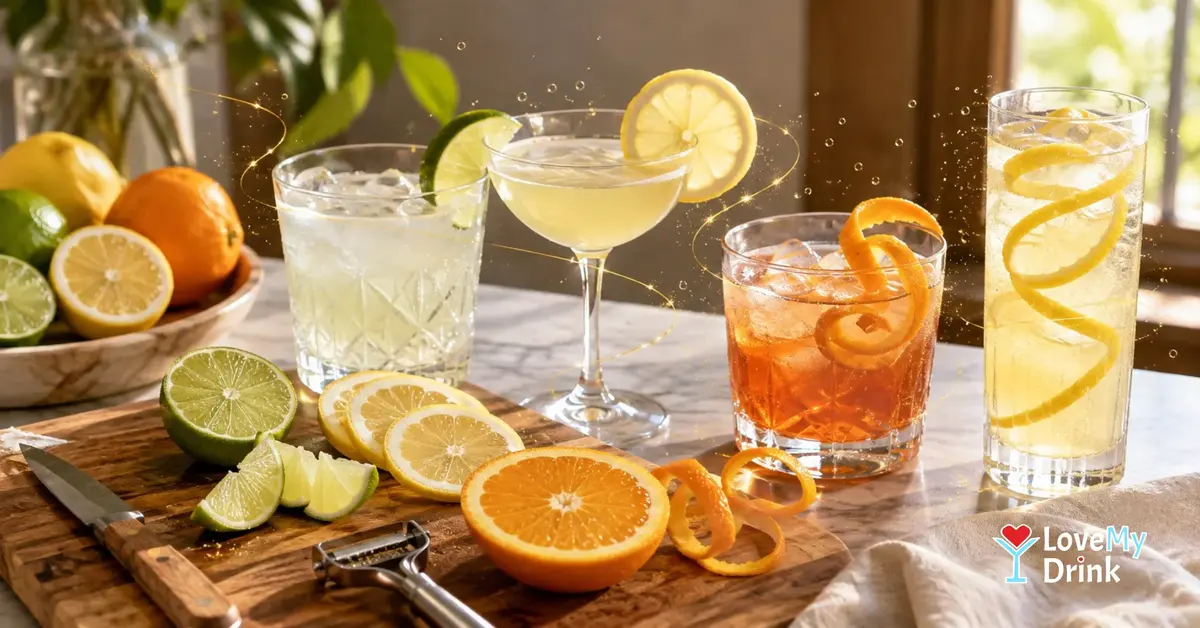
The quick rule: wedge, wheel, peel or twist?
- Wedge: choose it when you want the drinker to be able to squeeze in extra juice.
- Wheel or half-wheel: choose it for color and a clean, easy garnish on the rim.
- Peel or twist: choose it when you want citrus aroma without adding more juice.
- Long spiral: choose it when the garnish is mainly there to make a simple drink look more special.
That one distinction makes garnish choice much easier. You are not just decorating the glass; you are deciding whether the citrus should add juice, aroma or visual impact.
6 easy citrus garnishes for cocktails

1. Citrus wedge
The wedge is the easiest garnish to learn and one of the most useful. It looks casual, works with almost any glass and lets the drinker add an extra squeeze of citrus if they want it.
- Cut the lemon, lime or orange in half lengthwise.
- Place one half cut-side down and slice it into 3 or 4 wedges.
- To sit the wedge on the rim, make a small slit through the flesh near the center.
- Slide the slit over the edge of the glass.
Best for: Margaritas, Mojitos, Palomas, highballs and simple mixed drinks. Try the technique on our easy Margarita recipe, where a fresh lime wedge fits naturally with the drink.
2. Citrus wheel
A full wheel gives a drink a bright, classic look. It works especially well on tall glasses because the round shape is easy to see without making the garnish complicated.
- Place the whole fruit on its side.
- Cut crosswise into even rounds about 3–5 mm thick.
- Remove any obvious seeds.
- For a rim garnish, cut a small slit from the outer edge toward the center and slide it onto the glass.
Keep the slices fairly thin. A very thick wheel can feel heavy on a small glass and may slip off the rim more easily.
3. Citrus half-wheel
A half-wheel is the easy answer when a full wheel feels too large. You keep the color and recognizable citrus shape, but the garnish takes up less space.
- Cut a few thin citrus wheels.
- Slice each wheel neatly in half.
- Rest the flat edge against the rim or tuck the half-wheel beside the ice.
Best for: highballs, Collins-style drinks and smaller glasses. A lemon half-wheel is a neat option for a Tom Collins when you want something lighter than a full slice.
4. Broad citrus peel

A broad peel is one of the easiest ways to make a short cocktail look more polished. It also lets you release fragrant citrus oils over the surface without adding extra juice.
- Hold the fruit securely or place it on the cutting board.
- Use a Y-peeler to remove a broad strip about 5–8 cm (2–3 inches) long.
- If the white pith is very thick, trim a little away with a paring knife. Leave enough structure so the peel does not become flimsy.
- Hold the colored side of the peel toward the drink and gently bend it over the surface to release the oils.
- Drop it into the drink, rest it against the glass or lightly run the colored side around the rim first.
Best for: Old Fashioned-style drinks, Negroni-style cocktails and other short, spirit-forward drinks where you want citrus aroma rather than more acidity.
5. Simple citrus twist
A twist looks more polished than a plain peel, but you do not need perfect bartender curls. Start with a flexible strip and shape it gently.
- Remove a broad strip of lemon or orange peel with a Y-peeler.
- Trim the edges with a paring knife if you want a cleaner shape. This is optional.
- Hold the colored side toward the drink and gently bend the peel to release the oils.
- Wrap the strip around your finger or a spoon handle for a few seconds.
- Release it and place it on the rim or inside the glass.
Best for: Martinis, Cosmopolitans and elegant spirit-forward cocktails. Our Cosmopolitan recipe is a good example: an orange twist adds aroma and gives the drink a clean finish without adding clutter.
6. Long citrus spiral
The long spiral is the most decorative shape here. A channel knife is the easiest way to make it consistently. If you do not have one, use a peeler to remove a broad strip, lay that strip flat on the cutting board and carefully trim it into a narrower ribbon instead of trying to carve a spiral around the fruit with a paring knife in your hand.
- Start near one end of the lemon, lime or orange with the channel knife.
- Draw the tool around the fruit while slowly rotating the fruit away from the blade.
- Continue in one line until the spiral is as long as you want it.
- Gently loosen the strip and let it curl around the inside or outside of a tall glass.
Do not chase perfection. A slightly irregular spiral often looks more relaxed and natural at home than a garnish that feels over-styled.
Which garnish works with which cocktail?

There is no single correct garnish for every drink, but these pairings are useful starting points when you want the shape to suit both the glass and the cocktail.
- Margarita: lime wedge or thin lime wheel. Use the wedge when you want an optional extra squeeze of lime.
- Gin and Tonic: lime wheel, lemon wheel or a simple peel. Our classic Gin and Tonic is an easy place to try a clean citrus garnish.
- Tom Collins: lemon wheel or half-wheel. The shape suits a tall glass without taking over the drink.
- Cosmopolitan: orange twist or thin lime wheel. A twist adds aroma while keeping the presentation simple.
- Old Fashioned-style drinks: broad orange peel. It gives you citrus aroma without adding juice to a spirit-forward drink.
A useful test is simple: can you still pick up the glass and take a sip comfortably? If the garnish hides the drink, hits your face or keeps falling off, make it smaller.
5 common citrus garnish mistakes
Cutting wheels too thick
Very thick slices look heavy and are harder to balance on the rim. Aim for fairly thin, even cuts that still hold their shape.
Using soft or tired fruit
Soft citrus can collapse when you slice it, while dry peel is harder to shape. Fresher, firmer fruit is simply easier to work with.
Removing too much pith
A little white pith helps a peel stay strong. Trim only the thickest excess instead of trying to make the peel paper-thin.
Making the garnish bigger than the glass
More fruit does not automatically look better. A half-wheel can work better than a full wheel on a smaller glass, while a narrow peel can look cleaner than a huge strip.
Making twists too far ahead
Wedges and wheels are easy to prep in advance. Peels and twists are better closer to serving time, when the peel is still flexible and aromatic.
Quick garnish rescue guide
- Your wheel keeps tearing: cut it slightly thicker or turn it into a half-wheel.
- Your twist will not hold a curl: warm it between your fingers for a few seconds, then wrap it gently around a finger or spoon handle.
- Your peel is cracking: try fresher fruit and take a slightly wider strip.
- Your garnish keeps falling off the rim: make the slit a little deeper, but stop before you reach the center of the slice.
- The glass looks too busy: remove one element. One clean citrus shape is usually enough.
Can you prepare citrus garnishes ahead of time?
Yes. Wedges, wheels and half-wheels can be cut a few hours before serving. Keep them covered in the refrigerator so the cut edges do not dry out.
Peels, twists and spirals are best made closer to serving time. They are quick to cut, and freshly cut peel gives you the brightest aroma when you express it over the drink.
If you are building your home setup around simple techniques like these, our home bar essentials for beginners guide can help you decide which tools are worth buying first.
FAQ
Can I make a lemon twist without a channel knife?
Yes. Use a Y-peeler to remove a broad strip of peel, then twist it around your finger or a spoon handle. A channel knife is mainly useful for long, narrow spirals.
What is the easiest citrus garnish for beginners?
Start with a wedge. It is quick, forgiving and useful with many cocktails. A thin wheel is the next easiest shape to learn.
Do I need to remove all the white pith from a citrus peel?
No. A little pith gives the peel structure. Trim it only when the layer is very thick or bulky.
Can I use orange instead of lemon or lime for a garnish?
Often, yes, as long as the flavor suits the drink. Orange works especially well with richer, spirit-forward cocktails, while lemon and lime tend to give a brighter citrus character.
How far ahead can I cut cocktail garnishes?
Wedges, wheels and half-wheels can be prepared a few hours ahead and kept covered in the refrigerator. Make peels and twists closer to serving when you want the freshest aroma and appearance.
Make one clean cut and stop there
You do not need six garnish techniques every time you make a drink. Learn a wedge, a wheel and one simple twist first. That already covers most home cocktails. Add the spiral when you want a little extra drama, then let the drink stay the star.