Cocktail Strainers Explained: Hawthorne vs Julep vs Fine Mesh
Approx. 9 min read
The quick answer: which cocktail strainer should you use?
You do not need three strainers to start making good cocktails at home. Each one has a job, but there is a very simple way to remember the difference.
- Shaken cocktails: start with a Hawthorne strainer.
- Stirred cocktails: a Julep strainer is the traditional fit, although a Hawthorne works too.
- Tiny ice chips, herbs, pulp or fruit pieces: add a fine-mesh strainer for a cleaner pour.
The Love My Drink Strainer Rule: shaken → Hawthorne; stirred → Julep; tiny bits → fine mesh.
That is the useful version. The important second rule is that you do not need all three from day one.

If you are building your setup from scratch, our cocktail tools for beginners guide shows which pieces are genuinely useful first and which upgrades can wait.
Choose tools around the cocktails you actually make. A drawer full of specialist equipment does not automatically make better drinks.
Hawthorne strainer: the one most beginners actually need
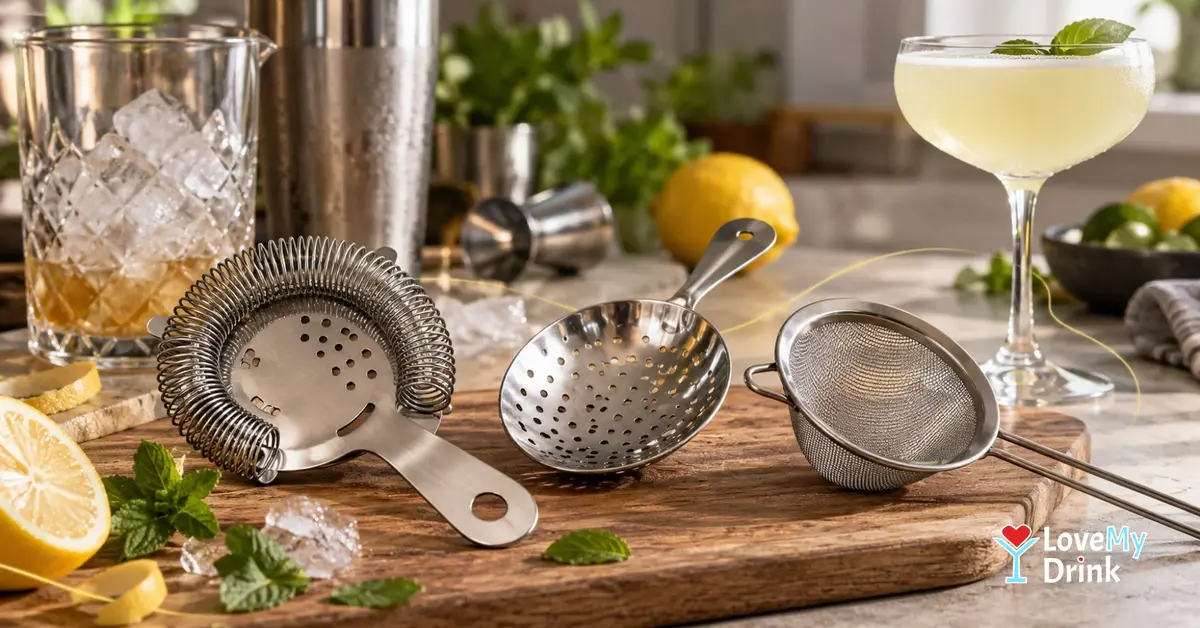
The Hawthorne is the strainer with the distinctive metal spring around its edge. It sits over a shaker tin or mixing vessel and holds back the large pieces of ice while the cocktail flows into the serving glass.
For a home bar, it is the most versatile place to start. If you use a two-piece Boston shaker, a Hawthorne is the natural companion because the shaker itself has no built-in strainer.
It works especially well for shaken drinks such as Daiquiris, Margaritas and Whiskey Sours. You can also use it perfectly well to strain a stirred cocktail from a mixing glass.
If you are still deciding between shaker styles, our Boston vs Cobbler shaker guide explains why a Boston setup normally needs a separate Hawthorne while a Cobbler has a strainer built into the lid.
Best for: most shaken cocktails, Boston shaker users and anyone buying one versatile cocktail strainer first.
Julep strainer: the traditional choice for stirred drinks
A Julep strainer looks like a large perforated spoon. It is designed to sit neatly inside a mixing glass and hold the ice back while you pour a stirred cocktail.
Think Martinis, Manhattans and other spirit-forward drinks made by stirring rather than shaking. The shape feels natural in a mixing glass, and the open holes let the finished cocktail flow quickly into a chilled serving glass.
But here is the part that matters for a beginner: you do not need a Julep strainer just because you make stirred cocktails. A Hawthorne can do the same basic job at home.
The Julep becomes worth adding when you regularly make stirred drinks and want a tool designed specifically for that workflow. It is a refinement, not a requirement.
Best for: Martinis, Manhattans and other cocktails stirred with ice in a mixing glass.
Fine-mesh strainer: when a cleaner drink really matters
A fine-mesh cocktail strainer solves a different problem. It catches the tiny things that can slip past a Hawthorne or Julep: small ice shards, citrus pulp, herb fragments, muddled fruit and similar particles.
In most cases, it is not used instead of the main strainer. It is used as a second filter.
Double straining means pouring through your main cocktail strainer and then through a fine-mesh strainer before the drink reaches the glass.

A Gin Basil Smash is a perfect example. The Hawthorne holds back the main ice and basil, while the fine mesh catches the little green fragments that would otherwise float through the finished drink.
Fine straining is also useful for fruit-heavy cocktails, drinks containing coffee particles and short cocktails served straight up when you want a particularly clean texture and surface.
You do not need to double-strain everything. A simple drink served over fresh ice may gain very little from the extra step.
Best for: herbs, muddled fruit, citrus pulp, tiny ice chips and polished straight-up cocktails.
Hawthorne vs Julep vs fine mesh: the simple comparison
- Hawthorne: most versatile; best first choice; especially useful with a Boston shaker and shaken drinks.
- Julep: specialist tool for stirred drinks and mixing glasses; useful but not essential for beginners.
- Fine mesh: secondary strainer for tiny particles; most useful when herbs, fruit, pulp or small ice fragments are involved.
If your goal is simply to make good cocktails at home, the Hawthorne covers the widest range of situations. Add the other two when your drinks give you a reason to.
Which cocktail strainer should you buy first?
Disclosure: This article contains affiliate links. If you buy through one of these links, Love My Drink may earn a commission at no extra cost to you. As an Amazon Associate, we earn from qualifying purchases.
If you want one strainer
Buy a Hawthorne cocktail strainer. It handles the widest range of home cocktails and is the obvious first purchase if you use a Boston shaker.
If you want two strainers
Start with the Hawthorne, then add a fine-mesh cocktail strainer. That combination covers normal straining and double straining, which makes it useful for everything from a simple Sour to cocktails with herbs or fruit.
If you make stirred cocktails regularly
Add a Julep cocktail strainer when Martinis, Manhattans and other stirred drinks become part of your regular rotation. It makes the mixing-glass workflow neat and comfortable, but there is no need to rush into buying one.
If you already know you want all three
A 3-piece strainer set can be the simplest way to build the complete setup in one go. It makes most sense when you genuinely expect to use all three styles rather than buying a kit just because it looks complete.
Five drinks that show when each strainer makes sense
Gin Basil Smash — Hawthorne + fine mesh
Fresh basil is exactly the kind of ingredient that makes double straining useful. Shake the drink, strain out the ice with a Hawthorne and let the fine mesh catch the smaller herb fragments. You can see the technique in our Gin Basil Smash recipe.
Whiskey Sour — Hawthorne, with fine mesh when useful
For a Whiskey Sour served over fresh ice, a Hawthorne is usually enough. If you are serving it straight up or want an especially smooth, clean surface, fine straining is a useful extra step. Our Whiskey Sour recipe shows both serving options.
Daiquiri — Hawthorne + fine mesh for a clean coupe
A classic Daiquiri is shaken and served without ice, so small ice chips are easy to notice. A Hawthorne followed by a fine-mesh strainer gives the cleanest result in a chilled coupe. Try it with our classic Daiquiri recipe.
Martini — Julep or Hawthorne
If you stir a Martini in a mixing glass, the Julep is the traditional tool for the job. But a Hawthorne will still strain the drink perfectly well. Use the tool you already own before treating the second one as essential.
Manhattan — Julep or Hawthorne
The same logic applies to a Manhattan. Stir the whiskey, vermouth and bitters with ice, then use a Julep if you have one or a Hawthorne if you do not. Our Manhattan recipe is a good drink for practising a clean stirred pour.
These are useful patterns, not rigid laws. The purpose of the strainer is to control what reaches the finished glass. If another tool you already own does that cleanly, your cocktail does not know the difference.
Four cocktail strainer mistakes that are easy to avoid
1. Using the fine mesh as your only shaker strainer
A small fine-mesh strainer is designed to catch tiny particles, not comfortably hold back a shaker full of large ice. Use a Hawthorne or built-in shaker strainer first, then fine-strain if needed.
2. Thinking a Julep is mandatory for stirred drinks
It is a lovely tool for a mixing glass, but it does not magically improve a Manhattan. Start with the strainer you already have and upgrade when the dedicated tool would genuinely make the process easier.
3. Double-straining every cocktail automatically
Fine straining is useful when there is something worth removing. If a drink is already clean and is being served over fresh ice, the second strainer may simply add another thing to wash.
4. Pouring too aggressively through fine mesh
Fruit and herbs can clog a fine strainer quickly. Pour steadily rather than dumping the entire shaker into it at once, especially when the cocktail contains muddled ingredients.
Cocktail strainer FAQ
Do I need a cocktail strainer with a Boston shaker?
Yes. A Boston shaker does not have a built-in strainer, so a Hawthorne is the usual choice for holding back the shaking ice while you pour.
Can I use a Hawthorne strainer for a Martini?
Yes. A Julep is traditionally associated with stirred drinks from a mixing glass, but a Hawthorne can strain a Martini perfectly well at home.
Why do bartenders use two strainers?
The first strainer holds back the main ice and larger ingredients. The fine-mesh strainer catches smaller ice shards, pulp, herbs or fruit particles. Using both is called double straining.
Can I use a kitchen sieve instead of a fine-mesh cocktail strainer?
Yes. A small clean kitchen sieve can perform the same basic job. A dedicated cocktail version is usually easier to hold over a coupe or small glass, but it is an upgrade rather than a necessity.
Do I really need a Julep strainer?
Not at first. If you mostly shake cocktails, buy a Hawthorne before a Julep. Add the Julep when you regularly make stirred drinks and want a tool that fits that workflow better.
Do I need another strainer with a Cobbler shaker?
Not for basic straining. A Cobbler shaker has a perforated strainer built into its lid. You may still add a fine-mesh strainer when you want to remove very small particles from the finished drink.
One good strainer is enough to start
If your home bar currently has no cocktail strainer at all, start with a Hawthorne. It handles the widest range of drinks and pairs naturally with a Boston shaker.
Add fine mesh when tiny bits start bothering you. Add a Julep when stirred cocktails become something you make regularly. That is the whole system: buy the next tool when it solves a real problem, not because a bartender kit says your drawer looks incomplete.